Oct 29, 2025

›
All articles
A Technical Comparison of Enterprise Automation Architectures
Introduction: The Enterprise Automation Dilemma
Enterprise leaders today face a significant challenge: automating increasingly complex business processes to maintain a competitive edge. The pressure to drive efficiency, reduce operational friction, and unlock new value is immense, yet the available tools present a difficult choice. For years, the landscape has been dominated by two primary architectural approaches: legacy Robotic Process Automation (RPA) and the newer, developer-focused cloud AI toolkits. Each comes with its own set of capabilities and fundamental limitations.
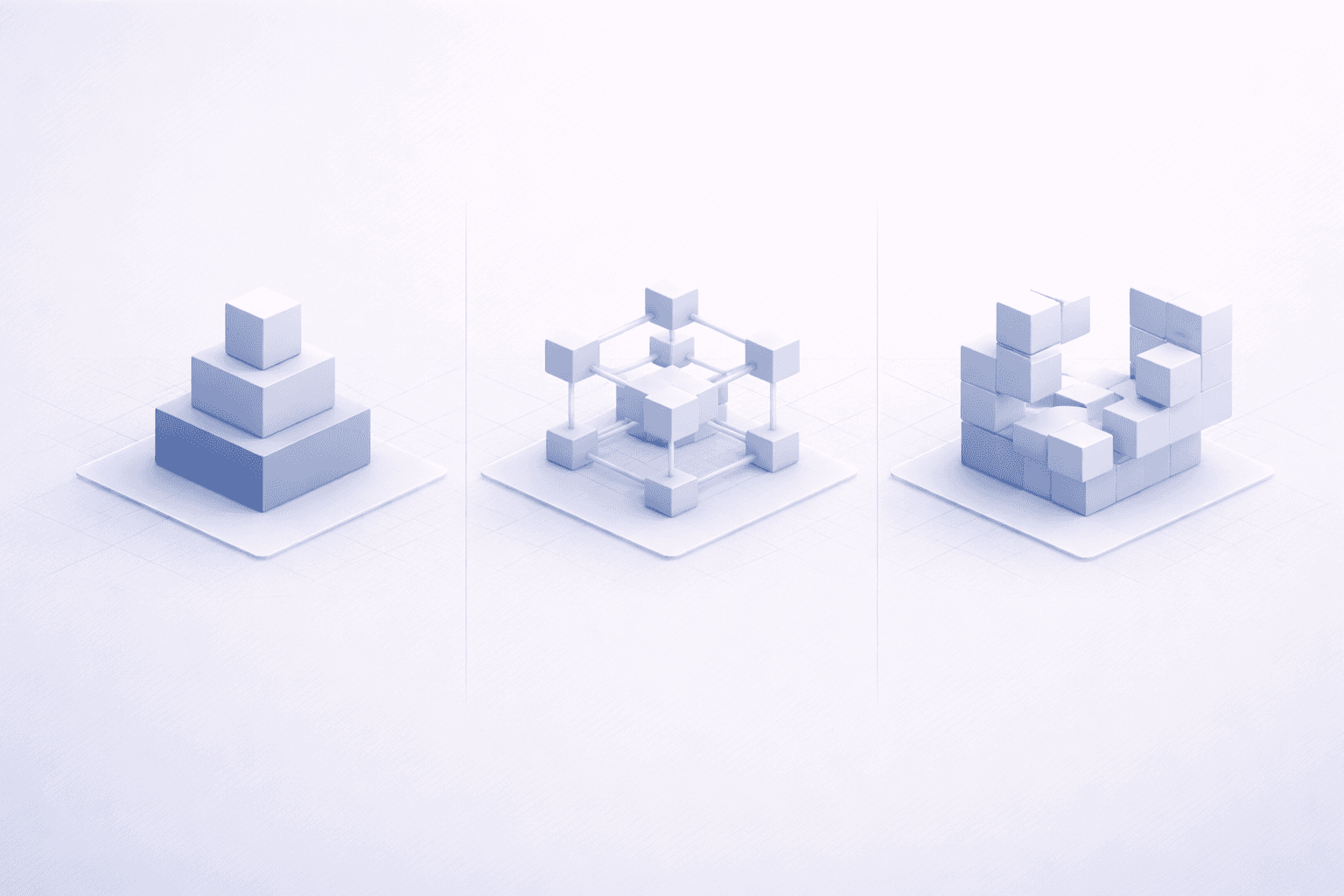
This article introduces a third architectural path, one designed specifically for the demands of orchestrating complex, mission-critical enterprise work: the purpose-built AI Workforce Operating System. To help technical leaders make informed decisions, we will compare these three distinct architectures. The analysis will focus on the criteria that matter most in an enterprise context: core architecture, orchestration capabilities, business logic integration, and the often-overlooked pillars of governance and auditability.
Approach 1: Traditional Robotic Process Automation (RPA)
Core Architecture
Robotic Process Automation platforms utilize software bots that are programmed to mimic human actions on a graphical user interface (GUI). As defined by industry leaders, RPA is fundamentally script-based and task-oriented, designed to follow a predefined set of rules to execute a process [1]. These bots interact with applications at the presentation layer, effectively acting as a digital user that clicks, types, and navigates through screens to complete its work.
Best Use Case
RPA excels at automating highly repetitive, stable, and rule-based tasks within applications that have predictable interfaces. Common examples include routine data entry, filling out forms, or processing simple transactions [2]. When the process is static and does not require complex decision-making, RPA can provide a straightforward path to automating high-volume, low-complexity work.
Limitations
The primary weakness of RPA is its brittleness. Because bots are tied to the GUI, they are prone to breaking whenever an application’s interface is updated. This creates a significant maintenance burden [3]. Furthermore, RPA systems struggle with unstructured data, complex exception handling, and dynamic decision-making. This makes them unsuitable for orchestrating dynamic, end-to-end business processes that span multiple systems and require cognitive flexibility. Scaling RPA solutions also presents governance and integration challenges, particularly in environments with legacy systems [4].
Approach 2: Generic Cloud Agent Builders
Core Architecture
Major cloud providers offer platforms like Amazon Bedrock Agents or Azure Copilot Studio, which provide toolkits for building single-purpose agents on top of large language models (LLMs) [5]. These are developer-centric frameworks, not fully managed systems. They give developers access to powerful foundation models and tools to connect them to APIs, but the responsibility for building, orchestrating, and governing the resulting agents falls entirely on the development team.
Best Use Case
These toolkits are well-suited for creating conversational interfaces, internal chatbots, or simple agents designed to perform a discrete task. Examples include an agent that summarizes a document, answers a natural language query based on a specific data source, or generates a code snippet. They are powerful tools for building AI-powered features and standalone applications.
Limitations
These platforms are toolkits, not a cohesive operating system. Orchestrating multiple agents to execute a long-running, multi-system business process requires significant custom development and deep expertise in state management and workflow engineering [6]. Critical enterprise features like business-aware governance, comprehensive auditability, and observability are not provided out-of-the-box. Teams must build these layers from the ground up, adding complexity and cost to any large-scale deployment.
Approach 3: The Qurrent AI Workforce Operating System
Core Architecture
The Qurrent OS is a specialized platform layer designed to build, deploy, and manage a workforce of AI agents. It functions as a central nervous system that understands business logic and orchestrates agents across disparate enterprise systems. Unlike RPA’s UI-level interaction, Qurrent agents integrate deeply into systems via APIs. Unlike generic cloud tools, the OS is purpose-built for managing the entire lifecycle of complex, automated processes. As detailed on our solutions page, the OS is built around core capabilities of orchestration, observability, and secure deployment, treating automation as a managed workforce, not a series of disconnected tasks.
This architecture enables agents to perform the full ‘perceive, decide, act, and self-reflect’ loop, a concept we explore in our article on AI agents, allowing for autonomous operation and continuous improvement. For example, consider a multi-stage procurement process. An ‘Invoice Agent’ perceives a new invoice in an email, extracts the relevant data, and passes it to a ‘Validation Agent’. The Validation Agent then decides to query the company’s ERP to confirm the purchase order and the CRM to check the vendor’s status. If an exception occurs, a ‘Resolution Agent’ acts by flagging the issue for human review, providing all necessary context. The Qurrent OS manages this entire stateful, long-running process, ensuring each specialized agent acts in concert to achieve the business outcome.
Comparative Analysis: Orchestration and Business Logic
RPA
Orchestration in RPA is typically linear and task-based. The logic follows a simple, sequential script. It cannot natively manage complex, stateful processes that may span days, involve multiple decision branches, or require dynamic adaptation based on new information. This limits its use to isolated segments of a larger business workflow.
Cloud Agent Builders
Multi-agent orchestration is not a native feature of these toolkits. While it’s possible to chain agents together, doing so requires extensive, custom-coded state management and workflow engines to handle the complex business logic. This approach essentially forces every organization to become a systems integrator, building the very orchestration layer that is missing from the platform [7].
Qurrent OS
The Qurrent OS features ‘Intelligent Process Orchestration’ as a core, native capability. It is architected from the ground up to manage long-running, complex business processes that require the coordination of multiple specialized agents. As highlighted in our Operate solution, the OS maintains the state of the entire process, manages exceptions, and ensures that agents collaborate effectively to achieve a defined business outcome, not just complete a task.
Comparative Analysis: Governance and Auditability
RPA
Audit trails in RPA systems are typically limited to logs of UI actions, such as ‘clicked button X’ or ‘copied field Y’. While this provides a record of what the bot did, it lacks the business context of why it did it. This makes true governance and compliance auditing difficult, as the decision-making logic is not transparently captured.
Cloud Agent Builders
Governance in this model relies on generic cloud security tools, such as identity and access management (IAM) policies. Creating a business-centric audit trail of an agent’s decision-making process requires building a custom logging and observability layer. This is a non-trivial engineering effort and is essential for meeting enterprise compliance standards, which increasingly demand explainability and transparency [8].
Qurrent OS
The Qurrent OS is designed to provide ‘full transparency’ and ‘observability’ into the AI’s decision-making process. Every step, decision, data point, and system interaction executed by the AI workforce is logged in a structured, business-aware format. This creates a comprehensive and fully auditable record that is ready for compliance reviews and provides complete control over critical operations. This level of built-in governance is a core tenet of our approach, as detailed on our solutions page and implemented through our rigorous AI methodology. The growing challenge of auditing agentic AI makes such a built-in feature a necessity, not a luxury [9].
Conclusion: Choosing the Right Architecture for Mission-Critical Work
The choice of automation architecture has profound implications for an enterprise’s ability to scale, adapt, and govern its operations. Traditional RPA remains a viable option for automating simple, stable, and repetitive tasks. Generic cloud agent builders are excellent tools for developers looking to create standalone AI features and conversational interfaces.
However, for automating complex, end-to-end business processes that are mission-critical and require high degrees of reliability, governance, and auditability, a different architecture is needed. These processes form the operational backbone of an enterprise, and their automation cannot be left to brittle scripts or cobbled-together toolkits. A purpose-built AI Workforce Operating System, like Qurrent’s, provides the necessary framework for orchestration, state management, and transparent governance that generic tools lack, representing a distinct and necessary category for the future of enterprise AI.